
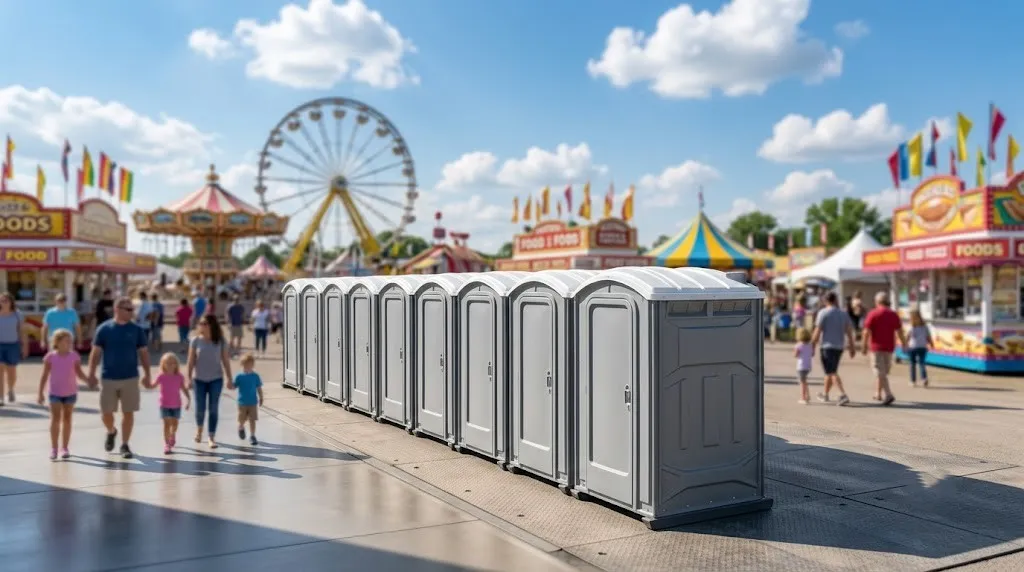
How Many Restrooms Does a County Fair Need?
Start with OSHA 1926.51(c), which sets 1 toilet for 20 workers and scales up from there for staff and vendors. Fair attendees are a different math problem entirely, since foot traffic clusters around gates, stages and the midway rather than spreading evenly across the grounds. Our how many porta potties do I need guide walks through attendance-based counts, but the short version is this: put more units near food courts and grandstands, fewer near open lawn.
A standard standard porta potty rental unit holds 60 to 70 gallons and stands about 92 inches tall, which matters when you're clustering ten or more units behind a stage where sightlines count. For multi-day fairs, service frequency matters more than raw unit count. ANSI/PSAI Z4.3 sets a baseline of one service visit per week for 10 users over a 40 hour week, but a fair packs that same usage into a single weekend, so we service more often and stage extra units instead of stretching the interval.
ADA Standards section 213.2 requires that at least 5 percent of a clustered bank of single-user units be accessible, with never fewer than one. Our ADA accessible porta potty units meet ADA Standards section 404.2.3 for door width and ADA Standards section 304.3.1 for the turning circle inside. Fairgrounds in Chula Vista and neighboring communities like Bonita, 5.7 miles north, run similar crowd patterns, so we size the accessible count the same way across both.
What Does It Cost to Rent Restrooms for a County Fair in Chula Vista?
Fair pricing runs by event day rather than a flat weekly rate, since most county fairs book a fixed multi-day run. A standard unit for an event books in the 200 to 800 dollar range depending on unit count and duration, and restroom trailer rental units run higher for fairs that want flush fixtures near VIP areas or sponsor tents.
| unit | duration | typical range |
|---|---|---|
| standard | event | 200 to 800 |
| ada | day | 230 to 400 |
| trailer | event | 3500 (2499 to 3899) |
| deluxe | week | 250 (150 to 290) |
| delivery_fee | event/day | 150 (100 to 500) |
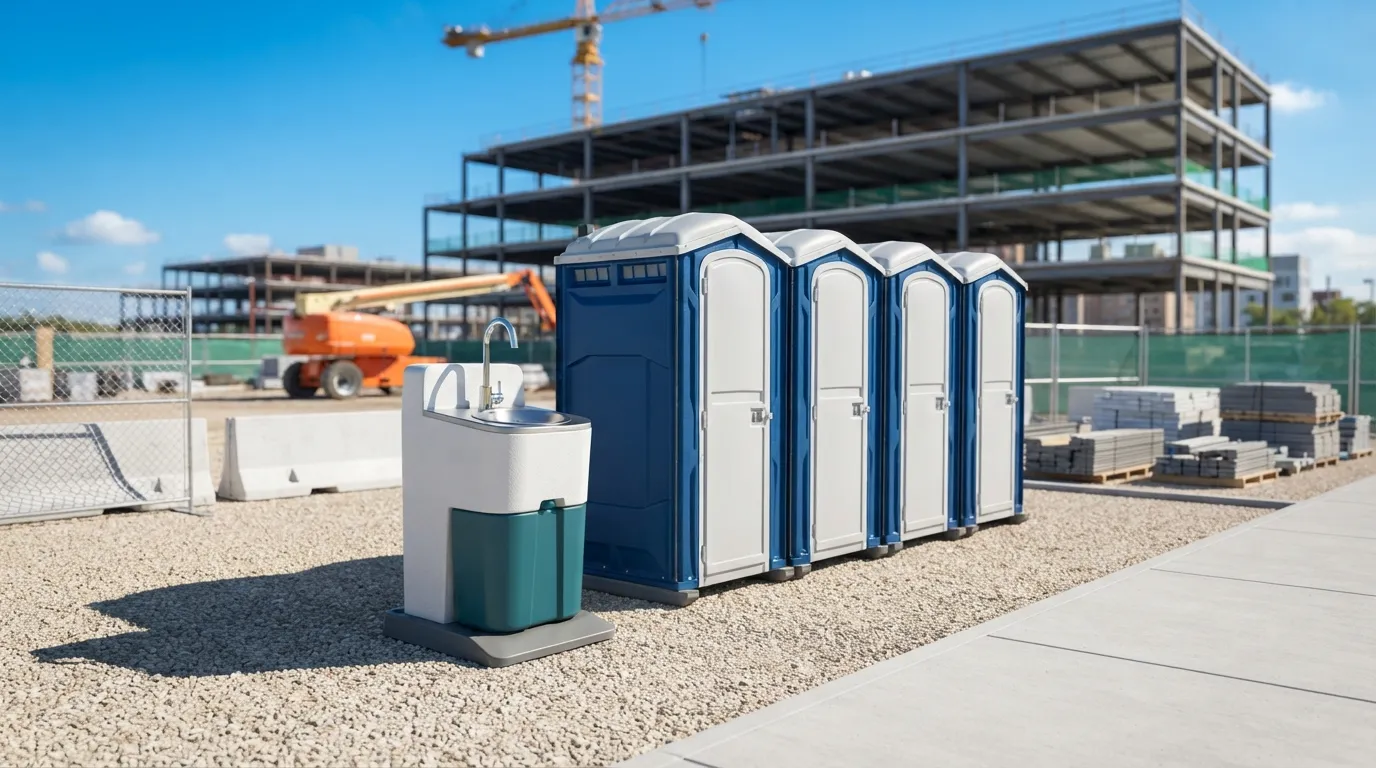
Multi-day fairs in Chula Vista often pair standard units for general crowds with a deluxe flushable porta potty bank near sponsor or VIP seating, and a restroom trailer rental or luxury restroom trailer for gated premium sections. Add a handwashing station rental at every food vendor row; 29 CFR 1910.141(d)(2) requires soap and towels or a hand-drying device at washing facilities, and hand sanitizer alone doesn't satisfy that. If any vendor booths spray coatings or use pesticides on-site, OSHA 1926.51(f)(1) requires washing facilities for that specific work. Delivery fees for fair-scale drops run 100 to 500 dollars depending on unit count and site access, separate from the unit price itself. For full cost breakdowns across all these options, see porta potty rental cost and restroom trailer rental cost.
Where Should Restrooms Go on a Fairground?
Placement drives satisfaction more than raw unit count does. ADA Standards section 403.5.1 requires 36 inches of clear route width to every accessible unit, so keep pathways to ADA clusters free of vendor tables, generator cords and fence panels. Our porta potty placement guide covers ground stability, and ADA Standards section 302.1 requires the surface itself be stable, firm and slip resistant, which rules out loose gravel or soft turf directly under accessible units.
Grandstands, midways and food courts each need their own bank rather than one central bathroom row, since a single distant location kills turnover during peak hours between shows. Pair restroom clusters with temporary fence rental or crowd control barrier rental to manage queue lines and keep foot traffic organized near stages. If the fairground borders a public right of way, confirm placement with the City of Chula Vista before setup; that rule isn't something we can quote from memory, so check with the city directly. Fairs drawing from Imperial Beach, 9.7 miles southwest, and La Presa, 10.4 miles north, tend to see heavier gate traffic on weekend days, so plan extra units near main entrances for Saturday and Sunday. Lighting matters after dark too; OSHA 1926.56(a) sets minimum illumination levels for work areas, and a light tower rental near restroom banks keeps nighttime lines visible and safe.
How far in advance should I book restrooms for a county fair?
Book as early as your fair date is confirmed, ideally 60 to 90 days out. Multi-day fair bookings compete with weddings and festivals for the same trailer and ADA unit inventory, and popular event weekends fill fast across Chula Vista and nearby cities.
Do I need ADA-accessible units at a county fair?
Yes. ADA Standards section 213.2 requires at least 5 percent of a clustered bank to be accessible, never fewer than one unit. Fairs with multiple restroom clusters need accessible units at each cluster, not just one central location.
Can vendor rows share restrooms with general fair attendees?
They can, but heavy food traffic usually needs its own bank plus a nearby handwashing station rental. Vendors handling raw food benefit from dedicated units close to their booths rather than a long walk across the grounds.
What's the difference between standard units and a restroom trailer for a fair?
Standard units handle general crowd volume at lower cost per unit. A restroom trailer rental adds flush fixtures, sinks and climate control, better suited to VIP areas, sponsor tents or multi-day fairs expecting heavy nightly use.
Who handles trash and grounds cleanup during a multi-day fair?
Pair your restroom order with a roll-off dumpster rental for vendor and grounds waste. OSHA 1926.25 covers housekeeping standards for keeping work and public areas clear of scrap and debris throughout the event.
Next step
Get a delivery date
Tell us the address, the dates and the headcount. We size the order and confirm the route.